

The last major-league pitch thrown in Brooklyn was in 1957. The Brooklyn Dodgers left for Los Angeles after that season, Ebbets Field came down in 1960, and the borough has lived with the grievance ever since. Professional baseball returned in 2001, but only as the Brooklyn Cyclones, a New York Mets affiliate in a 7,000-seat park on the old Steeplechase site at Coney Island. For a certain kind of Brooklyn loyalist, that has never been the same thing.
Bruce Blakeman, the Nassau County executive and Republican nominee for governor, is not a Brooklyn guy. He was born in Valley Stream in 1955, played basketball at Valley Stream Central, and built a career on Long Island: Hempstead Town Board, first presiding officer of the Nassau County Legislature, eight years as a Port Authority commissioner under George Pataki, and, since 2022, county executive. Allies nonetheless describe a long private obsession with the Dodgers’ departure, formed as a kid on the near side of the city line, and they have begun sketching, entirely on their own, how a Governor Blakeman might try to undo it.
The sketch is speculative. Blakeman has not proposed it.
What his supporters argue is that a governor can convene capital the way almost no one else in the state can: Empire State Development, the budget, infrastructure money, and a phone that real-estate families actually pick up. Around that convening power, they say, he could assemble an ownership group and take a Brooklyn expansion bid to Major League Baseball.
The names they reach for fall into three piles: people already in his political money circle, people who know how to build a New York waterfront, and people who already own the sports map of the city.

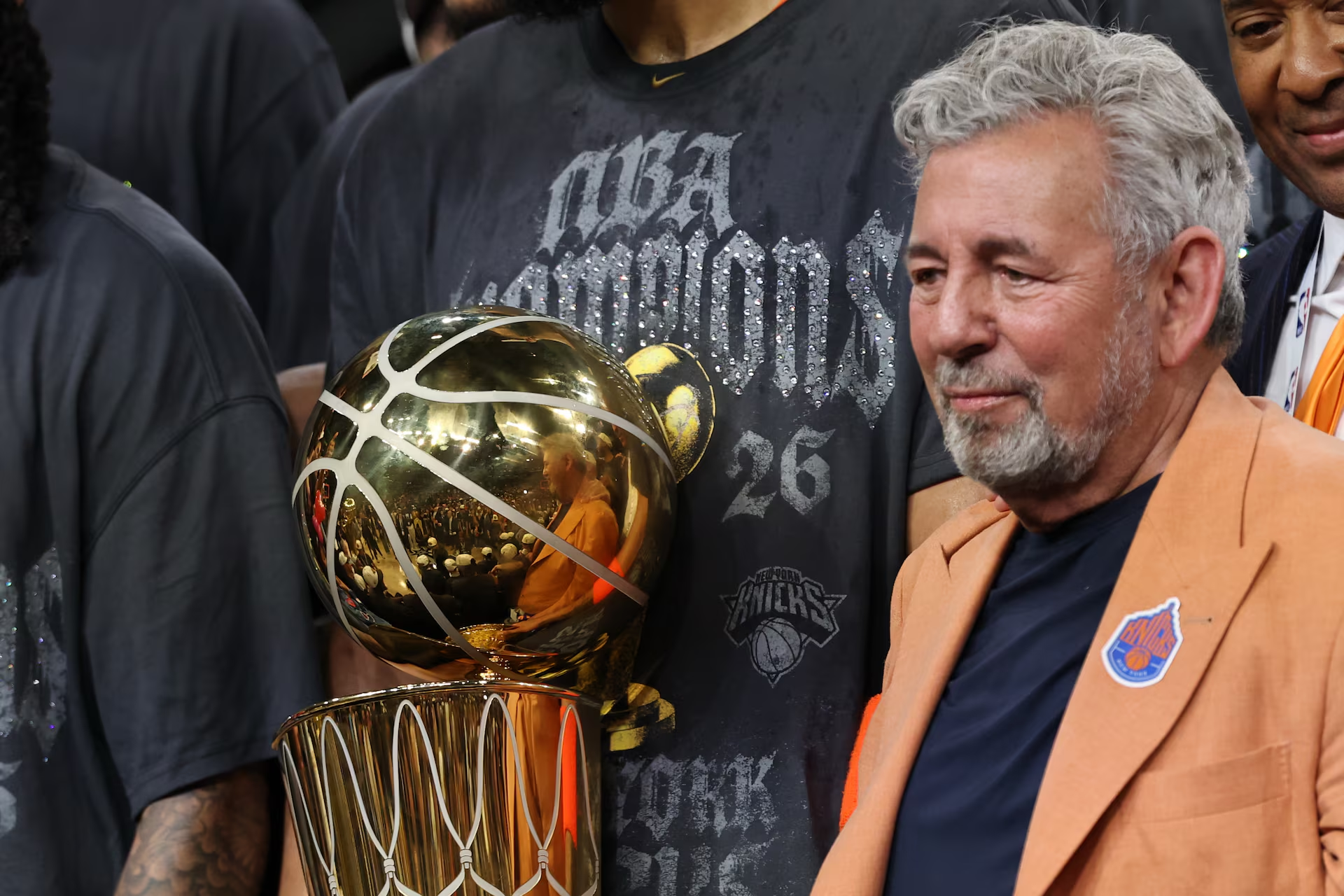
In the first pile, the Dolan family is the obvious call. James L. Dolan and six relatives gave a combined $970,200 to the Nassau County Republican Committee this cycle, and that committee has transferred more than $2 million to Blakeman’s campaign. Dolan controls the New York Knicks, the New York Rangers, and Madison Square Garden. A baseball franchise would be a different business from an arena company, and MSG’s territorial politics in the city are never simple, but supporters treat the Dolan checkbook as proof that sports ownership and Blakeman’s coalition already overlap.
Two other six-figure Nassau GOP donors sit closer to the dirt: David Mack, the Kings Point real-estate developer, and Harry Adjmi of A&H Acquisitions. Neither is a stadium builder. Both are the kind of outer-borough and Long Island money a governor’s allies would put on the first invitation list.
The second pile is the development bench, and it is where a ballpark actually gets built. Stephen Ross and Related Companies delivered Hudson Yards and already own the Miami Dolphins; a Brooklyn park wrapped in housing, a hotel, and a retail street is closer to Ross’s existing business than to a pure baseball bid.
Scott Rechler’s RXR has spent two decades on large New York sites and knows the MTA and the state development apparatus from the inside. Jed Walentas and Two Trees know the Brooklyn waterfront specifically, from Domino onward, including the community politics that kill projects which arrive as a rendering. Industry City’s ownership group, across Jamestown, Belvedere Capital, and Angelo Gordon, already sits on the Sunset Park waterfront that one of the candidate sites occupies.
None of these firms has been tied to a Blakeman baseball plan, yet. They are simply the short list of people who could finance a district, not just a team.
The third pile is the existing sports landlords, and any serious bid has to go through them whether they join or not. Steve Cohen owns the Mets and, through them, the Cyclones. He holds a territorial claim on New York and the only professional baseball brand currently operating in Brooklyn. He is as plausible a partner as an obstacle, and MLB would not award a second New York franchise without his consent or his compensation.
Joe Tsai already owns the New York Nets, the New York Liberty, and Barclays Center, which makes him the incumbent Brooklyn sports owner; a waterfront ballpark would compete with his building for dates, sponsors, and political attention, or it would give him a second venue.
Apollo Sports Capital, which this summer put $2.6 billion into Yankee Global Enterprises while leaving the Steinbrenners in control, is the model for a passive capital slice rather than a control buyer.
Gerry Cardinale’s RedBird has the sports-and-stadium thesis, though Cardinale has also said American franchise prices need to come down before he wants in.
The money is the easy part of the fantasy and the hard part of the reality. Recent control sales have priced franchises between roughly $1.7 billion and $4 billion. A new ballpark, even with a heavy private share, is a separate billion-dollar problem.
Expansion is a live conversation around the league, with Salt Lake City, Montreal, Orlando, and Portland among the cities that already have sites or public money in some stage of discussion. A Brooklyn bid would be late to that queue.
Land is the other problem, and it is where the supporters’ map gets specific. Five sites keep coming up. None is clean.

Coney Island is the sentimental choice and the worst fit for a major-league footprint. Maimonides Park already sits on the boardwalk, with the Parachute Jump in right field and the Wonder Wheel in left, a short walk from the Stillwell Avenue subway station. Transit is excellent and the tourism base is real. The site is also small, flood-exposed, and woven into an amusement district the city has spent two decades trying to stabilize. A 35,000-seat park would mean displacing the Cyclones or building beside them on land the neighborhood does not have.

Bush Terminal, the Sunset Park pier complex sometimes loosely called Bush Pier, is more serious. The industrial waterfront between Industry City and the Brooklyn Army Terminal has acreage, a working port character, and the N and R trains within reach of the upland blocks. A ballpark there could be argued as waterfront reuse rather than neighborhood clearance. The objections are the ones that attach to any working waterfront: maritime jobs, truck routes, and a community that has already absorbed one wave of rebranding. It is also the site where an existing ownership group, the Industry City Partners, already has a stake in the neighborhood.

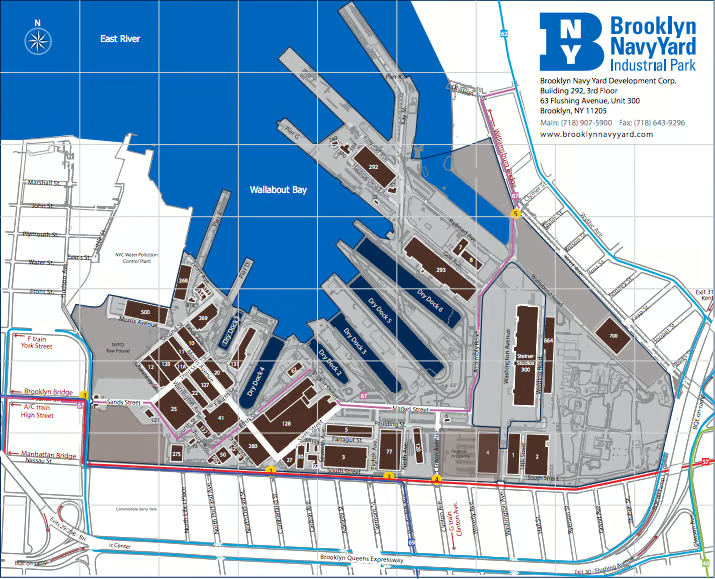
The Brooklyn Navy Yard is the prestige site and the least available. The Yard is a functioning industrial campus with ferry service and a political constituency that treats manufacturing space as something the city has finally stopped giving away. Large open parcels are scarce. A governor could lean on the state relationship. He could not simply clear a site.
Newtown Creek is the environmental long shot. The creek, a federal Superfund site between Greenpoint and Long Island City, is one of the most polluted waterways in the country. Some upland blocks are large enough, and the L train is not far. Remediation cost, flood risk, and the politics of putting a pleasure ground on a Superfund creek would dominate any review.

Red Hook is the site with the most land and the most conflict. The Brooklyn Marine Terminal covers roughly 122 acres of Red Hook and Columbia Street waterfront. The city’s vision plan, advanced with state participation through Empire State Development, calls for a 60-acre all-electric port, about 6,000 homes, a modernized cruise terminal, and 28 acres of open space. A ballpark could theoretically be carved from that program. It would also collide with a plan the task force has already blessed, and it would inherit Red Hook’s oldest handicap: no subway.

Of the five, Red Hook is the only one where the acreage is actually assembled. It is also the one where someone else already has a plan, which is why Ross, Rechler, or a Tsai-linked group would matter. They are used to arguing with a city over a waterfront someone else also wants.
The governmental path is narrower than the slogan. A governor does not zone Brooklyn. He does control Empire State Development, the state budget, and the ability to put public money and infrastructure on the table. Any real bid would be a three-way negotiation among an ownership group, Major League Baseball, and City Hall, with the Mets’ territorial sign-off as a fourth signature.
Supporters who tell this story are clear about the sequence. First the election. Then the calls, starting with the Dolans and the Long Island developers already in the coalition, then the waterfront firms that can actually deliver a site. The childhood wish is the romance. The franchise fee, the territorial payment, and a ballpark that does not flood are the work.

Be the first to comment