

BY STAFF REPORTER
Bruce Blakeman is privately floating a bold proposal for the Brooklyn Army Terminal that starts from a fact the City has lived with for forty years: the largest industrial building on the New York waterfront is still a City asset, managed by the New York City Economic Development Corporation, and still waiting for a use equal to its size.
Blakeman’s proposal ends that wait.
As envisioned, the State would work with NYCEDC to transfer ownership of the Sunset Park campus to Cornell University’s medical school, and Cornell would build there what the Upper East Side struggles to accommodate — a medical school expansion, a teaching hospital, and a research laboratory measured in millions of square feet rather than mere floors.
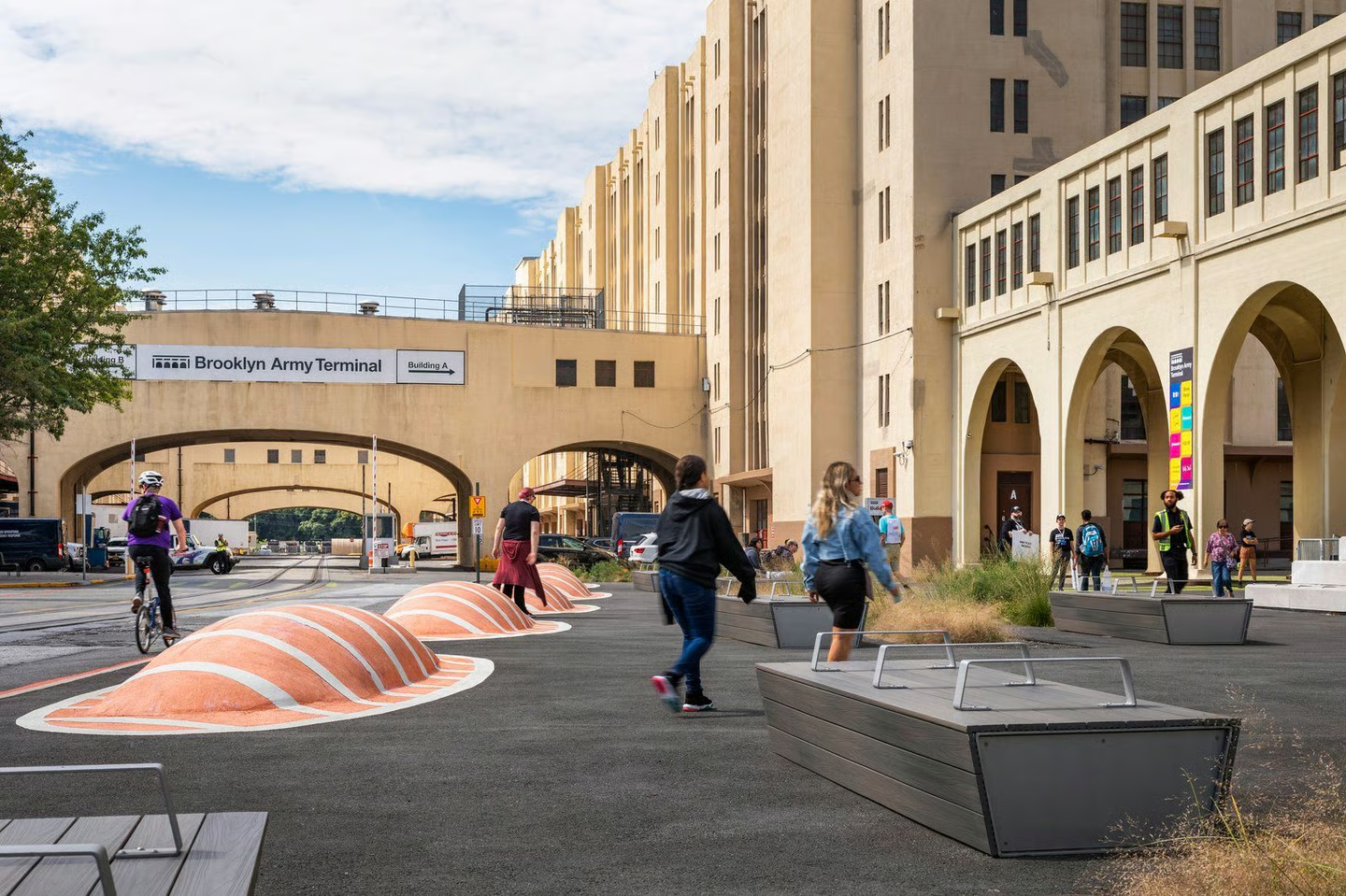
The property can take it. The terminal, designed by Cass Gilbert and opened in 1919, was the country’s largest military supply base through the Second World War, with more than 20,000 military and civilian personnel moving cargo through poured-concrete buildings that were, at the time, the largest of their kind. The Army closed the base in 1966. The City bought it in 1981. NYCEDC has managed it since 1986.
What stands there now is a 59-acre waterfront campus at 140 58th Street, roughly 4.1 million square feet in two eight-story buildings, about 3.1 million of it rentable, with another 900,000 square feet still developable. Floors are rated to 250 pounds per square foot. Freight elevators run to 10,000 and 20,000 pounds. There are 118 loading docks, on-site rail, highway access, a working pier, and a ferry that reaches Manhattan in about twelve minutes.
That is hospital and laboratory infrastructure already poured. Imaging suites, cyclotron vaults, good-manufacturing-practice lines, and device prototyping shops all want heavy floor loads, freight elevators, and docks. A conventional medical campus has to build those conditions. The terminal already has them.

Weill Cornell Medicine needs the room. The medical school and its teaching hospital, NewYork-Presbyterian/Weill Cornell, sit on a landlocked Upper East Side block at York Avenue and 68th Street, an 862-bed hospital beside research towers that include the $650 million Belfer Research Building. The science there is already aimed at the diseases a second campus would be built to chase: cancer, cardiovascular and metabolic disease, neurodegeneration, pediatrics, and infectious disease. What the Upper East Side cannot offer is a site large enough for a new medical school class, a new hospital, and the laboratory volume that translational work now requires.
Cornell Tech, a ferry ride north on Roosevelt Island, has shown that a Cornell graduate campus in the city can draw industry to it — roughly 700 students, more than 100 startups, and an estimated $768 million a year in city economic impact. It is a digital campus, not a clinical one. The terminal would be the clinical and laboratory counterpart.
The research linkages run through the rest of the university, not just the medical school.
Cornell Tech is the nearest. Its health-tech degree, run with the Technion, and its strength in data science and electrical engineering sit one ferry stop from a campus that could generate the clinical data, devices, and trials those programs are built to use. A Brooklyn laboratory that cannot talk to Roosevelt Island wastes both.
The Meinig School of Biomedical Engineering in Ithaca has spent two decades short of purpose-built space, sharing research floors and teaching labs. A Sunset Park device shop, with floor loads and docks the Ithaca campus will never have, is where implantable devices, surgical robotics, and imaging hardware get built rather than simulated. Faculty already hold joint appointments between Weill Cornell, Cornell Tech, and Ithaca.
The terminal would give that triangle a factory floor.

The College of Veterinary Medicine, a statutory college in Ithaca, is the comparative-medicine half of the same problem. Zoonotic disease, translational models, and diagnostic scale-up are what a veterinary college and a medical school do together when they share a laboratory rather than a quarterly symposium. The College of Agriculture and Life Sciences brings nutrition, microbiology, and the food-system science that already has a foothold among the terminal’s existing food manufacturers. The Bowers School of Computing supplies the imaging informatics and clinical-data work that radiology at Weill Cornell has made a priority. The College of Architecture, Art, and Planning is the school that would have to solve the building itself: an adaptive reuse of a Cass Gilbert industrial monument, not a glass box on a cleared pier. The School of Industrial and Labor Relations is the practical link to the workforce question the transfer cannot dodge.
The terminal is not empty. It holds more than 100 businesses and about 3,500 to 4,000 jobs, in advanced manufacturing, food production, fashion, and climate-tech prototyping. NYCEDC has spent decades, and more than $500 million in the last ten years, turning a surplus Army base into that campus. It is mid-stream on BATWorks, a climate-innovation hub of about 200,000 square feet in Building A, backed by up to $100 million, aimed at 150 startups and a claimed $2.6 billion in impact, with a permanent opening targeted for 2028. The zoning is M2-1, medium manufacturing. A hospital is not a currently permitted use there.
The City, not the State, owns the land.

A transfer therefore cannot be a seizure dressed up as a partnership. It has to be negotiated with NYCEDC, phased against existing leases, and paired with a relocation plan into the rest of the Sunset Park district — MADE Bush Terminal, the South Brooklyn Marine Terminal, the Brooklyn Wholesale Meat Market — or the Navy Yard.
Clinical buildings need a rezoning and a full land-use review. Research and prototype manufacturing can begin inside the existing industrial envelope, which is the sequence that makes the site usable before a hospital tower is entitled. Tenants who leave without a landing place will define the politics of the project long before the first laboratory opens. Proponents believe displacement can be avoided altogether.
Done in that order, the campus is a different kind of medical center from the one on York Avenue. The Upper East Side hospital is a referral palace. A Sunset Park hospital on a working waterfront, beside NYU Langone Hospital–Brooklyn, Maimonides, and SUNY Downstate, would be a borough hospital with a research university attached — closer to the patients the East Side campus sees mostly as transfers. The laboratory volume, the freight capacity, and the pier are what let Cornell do something the East Side campus cannot: manufacture what it invents, on the same site where it treats the patients who need it.
Blakeman’s plan is a conveyance, not a rebranding. The State works with NYCEDC. Ownership moves to the medical school. Cornell builds the school, the hospital, and the laboratories the buildings were strong enough to hold in 1919. The rest of the university — engineering, veterinary medicine, computing, Tech, architecture — supplies the work that keeps the campus from becoming a satellite. The test is whether the 4,000 people already there are brought into the plan rather than allowed to be displaced. The opportunity is a medical research campus New York does not have, on a waterfront it already owns.


Be the first to comment