

Mayor Zohran Mamdani has begun to say, in private and increasingly in public, that a Bruce Blakeman governorship would do more than reverse the city’s progressive turn. It would reopen a question Albany has spent three decades pretending was closed: whether Staten Island remains part of New York City at all.
He is right to worry. He is wrong about who would be harmed.
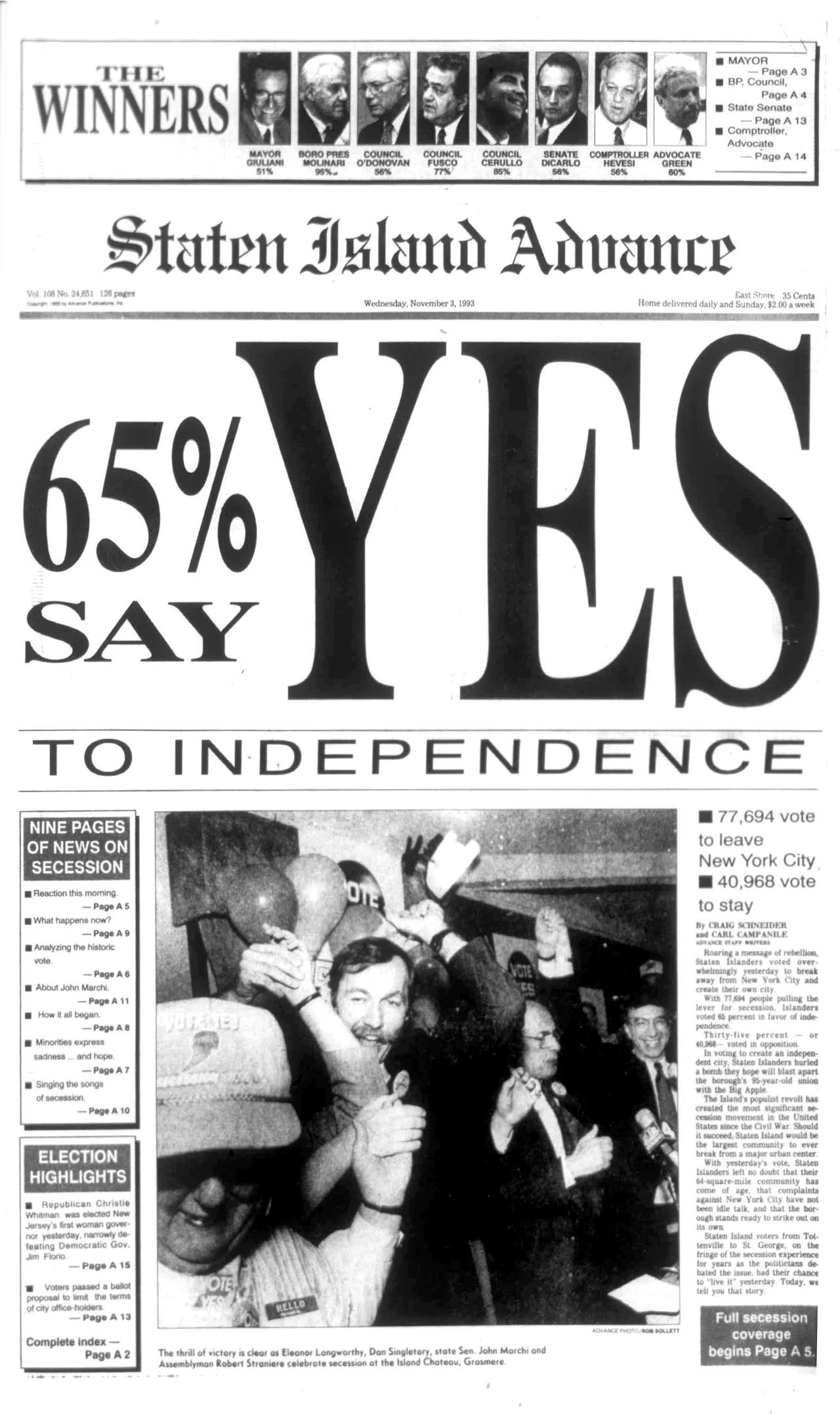
The island has already answered. In November 1993, on the same day Rudolph Giuliani unseated David Dinkins, Staten Islanders approved a charter for a City of Staten Island by 81,566 votes to 43,160 — 65 percent to 35. A companion question passed by a wider margin. The grievance was not a mood. In 1989 the Supreme Court dismantled the Board of Estimate, the one place where the island’s borough president had weighed the same as Manhattan’s.
Power moved to a Council on which Staten Island holds three of 51 seats. Five percent of the population, three votes, and for half a century the landfill that took the rest of the city’s garbage.
Senator John Marchi built a lawful path out. Governor Mario Cuomo signed the study bill and then left the finish to the Legislature. Assembly Speaker Sheldon Silver refused to call the vote. The mandate sat on the table. It did not expire.
What Mr. Mamdani treats as a threat is, for the people who would live under it, the ordinary promise of a city that can hear itself. A municipality of nearly half a million would be the second-largest in New York State on the day it was chartered, large enough to run schools, a police department, and a sanitation force, and small enough that a parent, a precinct commander, and a taxpayer could find the person who decided. That is the case for leaving. Decentralized government is not a slogan on the island. It is the difference between a policy written for 8.5 million people and one written for Richmond County.
Schools are the clearest gain
Staten Island’s children are taught inside a Department of Education built for the other four boroughs: on the order of 90 schools and roughly 72,000 resident students, several thousand of whom now leave the island for specialized seats whose rules are set elsewhere.
An independent district would not abolish those ambitions. It would let an elected board decide which of them to keep, and which fights — curriculum, discipline, admissions, the use of bathrooms and locker rooms — belong to the parents who show up.
Mr. Blakeman has already said he would settle the last of those questions statewide. A Staten Island board could settle them on Tuesday. Special education would have to be funded locally, and that is a real bill. It is also a bill the island could see, debate, and amend, instead of absorbing a citywide formula negotiated by interests that do not ride the ferry.
Local control does not make a hard subject easy. It makes the people who live with the result the people who chose it.
Policing would stop being Manhattan’s fault
The island has four of 77 precincts, and its politics have spent years asking for two things the larger city will not grant together: more local accountability and attentiveness to hyper-local neighborhood safety issues. A City of Staten Island police department could have both. It would hire for the island, answer to an island commissioner, and surge where the island surges — the Expressway, the malls, the North Shore — rather than wait on a citywide deployment decision made in Manhattan. Training and laboratories now concentrated in other boroughs would have to be replaced or contracted. That is a transition, not a refutation. The political fact is simpler. The voters who have asked for a different kind of policing would finally employ the officers who provide it.
Keeping tax dollars local
Taxes are where the island’s own record is more encouraging than City Hall’s. The state charter commission that reported to Cuomo in February 1993 tested the threshold question the Legislature had assigned it — could Staten Island function without fiscal collapse? — and found, under the scenarios it ran, that the borough generated more than it received.
Later city studies disagree, and a negotiation over general-obligation debt would be long and lawyerly. None of that erases the advantage of setting the rate at home. Property taxes, commercial assessments, and the exemptions that now shelter or squeeze homeowners would be arguments among Staten Islanders, not line items in a budget written to balance Manhattan and the Bronx.
A city that keeps what it raises can also cut what it resents. Mr. Blakeman’s statewide plan to exempt the first $50,000 of individual income, and the first $100,000 for married couples, suggests the direction. An independent island could go further, faster, and mean it.
Transportation that hears Staten Islanders
Transportation is the daily proof that decision-making elsewhere has a cost. The Expressway is a parking lot. The Outerbridge Crossing is two lanes of 1950s geometry. The ferry is free only because a mayor who needed the island’s votes made it so, and it remains a city boat. The railway and the buses are state services, and would remain so.
What would change is the party across the table.
A City of Staten Island could bargain for the railway subsidy, the resident toll rebate, and the ferry schedule as a municipal government rather than as three Council members. Mr. Blakeman has already stood on a walkway over the Expressway and promised a new Outerbridge, three lanes each way, on the model of the rebuilt Goethals, plus a high-occupancy lane the length of the island.
A governor willing to sign a secession bill would be a governor already committed to treating the island’s roads as a state priority. Independence would not build the bridge. It would make the bridge’s beneficiaries the clients, not the petitioners.
None of this requires romanticizing the paperwork. Pensions, union contracts, and the allocation of old debt would take years, as the Independent Budget Office has said. The second-largest city in the state would still sit inside the metropolitan transportation district and still cross bridges it does not own. Those are the terms of every new city in America.
They are not a reason to leave 500,000 people governed by a Council in which they cannot win a vote.
Mr. Mamdani’s worry is that Mr. Blakeman, if elected on November 3, would let the 1993 mandate become law.
For Staten Island, that is not the risk. That is the point of electing him.


Be the first to comment